The newton (symbol: N) is the International System of Units (SI) derived unit of force. It is named after Isaac Newton in recognition of his work on classical mechanics, specifically Newton's second law of motion.
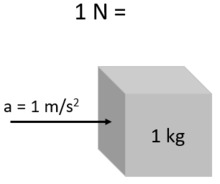
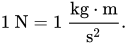
A newton is defined as 1 kg⋅m/s2, which is the force which gives a mass of 1 kilogram an acceleration of 1 metre per second, per second.
Definition
A newton is defined as 1 kg⋅m/s2 (it is a derived unit which is defined in terms of the SI base units).[1] One newton is therefore the force needed to accelerate one kilogram of mass at the rate of one metre per second squared in the direction of the applied force.[2] The units "metre per second squared" can be understood as a change in velocity per time, i.e. an increase of velocity by 1 metre per second every second.
In 1946, Conférence Générale des Poids et Mesures (CGPM) Resolution 2 standardized the unit of force in the MKS system of units to be the amount needed to accelerate 1 kilogram of mass at the rate of 1 metre per second squared. In 1948, the 9th CGPM Resolution 7 adopted the name newton for this force.[3] The MKS system then became the blueprint for today's SI system of units. The newton thus became the standard unit of force in the Système international d'unités (SI), or International System of Units.
The newton is named after Isaac Newton. As with every SI unit named for a person, its symbol starts with an upper case letter (N), but when written in full it follows the rules for capitalisation of a common noun; i.e., "newton" becomes capitalised at the beginning of a sentence and in titles, but is otherwise in lower case.
In more formal terms, Newton's second law of motion states that the force exerted on an object is directly proportional to the acceleration hence acquired by that object, namely:[4]

where 


Examples
At average gravity on Earth (conventionally, g = 9.80665 m/s2), a kilogram mass exerts a force of about 9.8 newtons. An average-sized apple exerts about one newton of force, which we measure as the apple's weight.[5]
- 1 N = 0.10197 kg × 9.80665 m/s2 (0.10197 kg = 101.97 g).
The weight of an average adult exerts a force of about 608 N.
- 608 N = 62 kg × 9.80665 m/s2 (where 62 kg is the world average adult mass).[6]
Commonly seen as kilonewtons
It is common to see forces expressed in kilonewtons (kN), where 1 kN = 1000 N. For example, the tractive effort of a Class Y steam train locomotive and the thrust of an F100 jet engine are both around 130 kN.
One kilonewton, 1 kN, is equivalent to 102.0 kgf, or about 100 kg of load under Earth gravity.
- 1 kN = 102 kg × 9.81 m/s2.
So for example, a platform that shows it is rated at 321 kilonewtons (72,000 lbf), will safely support a 32,100-kilogram (70,800 lb) load.
Specifications in kilonewtons are common in safety specifications for:
- the holding values of fasteners, Earth anchors, and other items used in the building industry;
- working loads in tension and in shear;
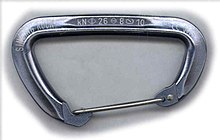
- rock-climbing equipment;
- thrust of rocket engines, Jet engines and launch vehicles;
- clamping forces of the various moulds in injection-moulding machines used to manufacture plastic parts.
Conversion factors
See also
| This article uses material from the Wikipedia article Metasyntactic variable, which is released under the Creative Commons Attribution-ShareAlike 3.0 Unported License. |